Sunday, July 29, 2018

James Tissot

Today I learned a little about the artist James Tissot (1836-1902), who early in his career became famous for his exquisite depictions of French fashion and high society, especially beautiful women dressed in their finery. Click here for a look at 492 of this artist's paintings by either popularity or alphabetical order. 

When Tissot was in his late forties, he set about working on  a new project depicting Parisian women in a variety of settings. These settings included  a Catholic church. One day, while visiting the church, Tissot had a profound experience that was to change the rest of his life. While the priest was conducting mass, Tissot experienced a vision: Christ comforting the poor in the rubble of a fallen building. Doing without sleep for several nights, Tissot set to work painting the scene as it appeared to him. He called it Inward Voices: The Ruins.

From then on, the focus of his artistic endeavors shifted. He traveled to Egypt, Syria and Palestine in 1886, and again in 1890 in order to create a series of paintings resembling as close as possible the world in which Jesus walked. The result was a series of 350 watercolors which took nearly 10 years to complete.
The crowds thronged wherever these works were placed on exhibit. Tissot also published a four volume international bestseller featuring the watercolors (To be fair,  some of Tissot’s friends and peers implied his shift in focus may have been partly related to financial considerations due to changing political winds).

Later in life, Tissot began to paint a series of Old Testament paintings but sadly died before making his way out of the book of Genesis.


Tuesday, June 26, 2018

Painter Of The Week


The artist I learned about this week is the English Pre-Raphaelite William Holman Hunt. Two of his paintings seem to be in dialogue with each another. The first is The Awakening Conscience (1853), and the second is The Light Of The World (1854). I read about the artist in the book 75 Masterpieces Every Christian Should Know. This wiki is also very informative.

Saturday, March 10, 2018

Perfectly Balanced Universe

Another reminder from Neil DeGrasse Tyson's Astrophysics for People in a Hurry:

  "Since both mass and energy cause space-time to warp, or curve, omega tells us the shape of the cosmos. If omega is less than one, the actual mass-energy falls below the critical value, and the universe expands forever in every direction for all of time, taking on the shape of a saddle, in which initially parallel lines diverge. If omega equals one, the universe expands forever, but only barely so. In that case the shape is flat, preserving all the geometric rules we learned in high school about parallel lines. If omega exceeds one, parallel lines converge, and the universe curves back on itself, ultimately recollapsing into the fireball whence it came."

What a perfectly balanced universe in which we live!


Graphics: Wikipedia, Northern Arizona University

Our Unique Vantage Point

Earlier this year I listened to Neil DeGrasse Tyson's Astrophysics for People in a Hurry and I've been slowly re-reading the ebook. One of many fascinating observations Tyson makes regarding our unique position in the universe is as follows:

"Earth’s Moon is about 1/400th the diameter of the Sun, but it is also 1/400th as far from us, making the Sun and the Moon the same size on the sky—a coincidence not shared by any other planet–moon combination in the solar system, allowing for uniquely photogenic total solar eclipses. Earth has also tidally locked the Moon, leaving it with identical periods of rotation on its axis and revolution around Earth. Wherever and whenever this happens, the locked moon shows only one face to its host planet." --Astrophysics for People in a Hurry"

What an amazing universe in which we live!


Saturday, December 9, 2017

2017 Reading

Wow... almost a year has passed since my last blog entry! Time again for my year in books review.

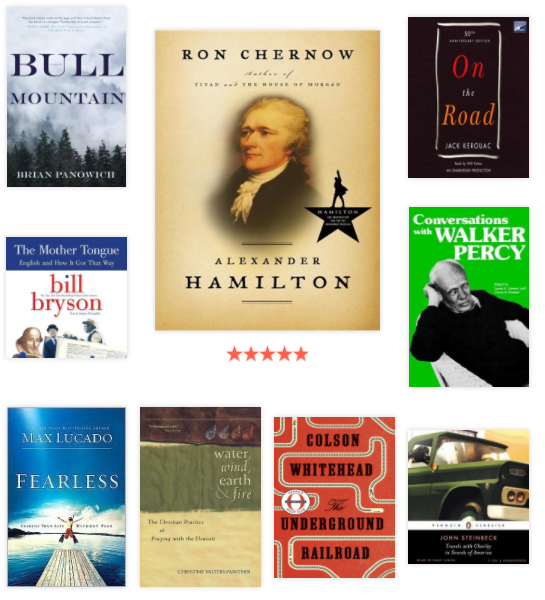
As I look back over the list of 48+ books I listened to or read this past year, my first observation is that I read several more novels than I usually do. I loved the humor of The Throwback Special, and the gritty earthiness of Bull Mountain and The North Water. The Atonement wasn’t bad, but The Girl on the Train was awesome! I liked Thomas McGuane’s Crow Fair: Stories so much that he's near the top of my reading list for 2018. However, my favorite novel for the year was by far Fyodor Dostoyevsky’s classic masterpiece The Brothers Karamazov!


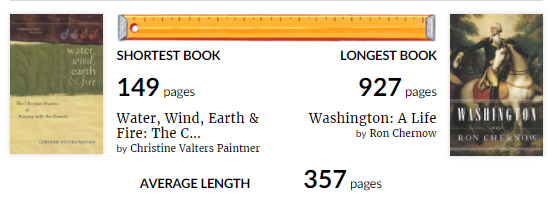
In  the history and biography genre, I thoroughly enjoyed listening to Destiny of the Republic: A Tale of Madness, Medicine and the Murder of a President. I can also recommend Ron Chernow’s Alexander Hamilton as well as his Washington: A Life. Jon Meacham’s Destiny and Power: The American Odyssey of George Herbert Walker Bush kept my attention from start to finish, although the author seemed at times a little biased, perhaps due to being a little too close to his subject material. My favorite for the year in the biography genre was by far George Whitefield: America's Spiritual Founding Father. Highly recommend this title!


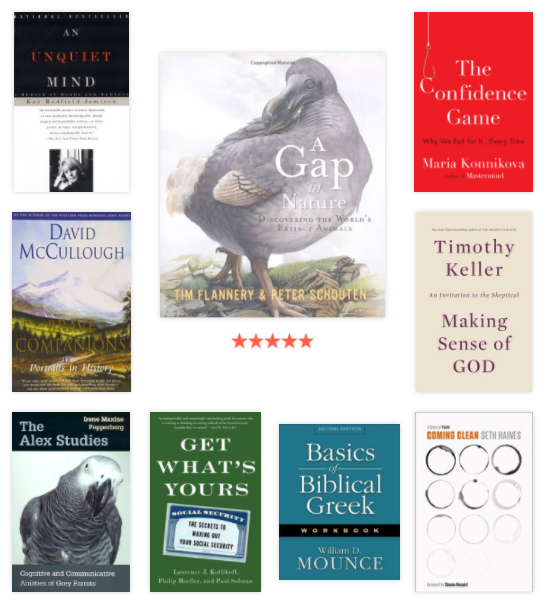
I only read three science-related books this year, but all three were eye-opening: The Gene: An Intimate History, A Gap in Nature: Discovering the World's Extinct Animals, and Missing Microbes: How the Overuse of Antibiotics Is Fueling Our Modern Plagues. I highly recommend all three.


One area I wanted to learn more about this past year was the issue of justice and the command for us to prioritize it instead of looking the other way. I heartily recommend both Seeking Refuge: On the Shores of the Global Refugee Crisis, and The Justice Calling: Where Passion Meets Perseverance. Other non-fiction which I found challenging and edifying included Conversations with Walker Percy, and Tim Keller’s Preaching: Communicating Faith in an Age of Skepticism.


An important personal goal for me the past year was to re-acquire the Greek and Hebrew I studied years ago in graduate school which I for the most part neglected for 20 years as I moved on to other languages. To accomplish this, I read Basics of Biblical Hebrew Grammar and its companion Basics of Biblical Greek as well as worked through portions of their accompanying workbooks. I’ve still got a long way to go to get to the next level. But that’s a goal for next year.

The book formats I read this year were as follows:
27 audiobooks (ever thankful to take advantage of commuting time!)
16 eBooks (7 along with same audiobook)
10 physical books

There are always a few books I forget to input, but that’s it for the most part. How about you? Did you read any of these or have other favorites to recommend? Please let me know!


If you're interested in checking out my reviews (or those of others) for any of these books, you can click here.